Memorial Jewelry: Six Types Compared, Cheapest First
Memorial jewelry solves a specific problem. An urn stays on a shelf at one person's house. A grave is somewhere you visit. A piece of jewelry goes to work, to the wedding, to the hospital waiting room — it is the only form of remembrance that comes with you on an ordinary Tuesday.
It is also a category with a wide spread of quality and a wider spread of price, sold mostly online, often to people making the decision in the worst month of their lives. This is a guide to what actually exists, ordered from least to most expensive — you can check that against the price column on each type.
Six Types, Compared
| Type | Typical cost | Contains | Best for |
|---|---|---|---|
| Engraved or photo locket | $30–$200 | Nothing physical | Anyone; no ashes required |
| Urn pendant | $40–$300 | A pinch of ash | The most common choice |
| Fingerprint or handwriting | $80–$500 | An impression, not remains | People who dislike carrying ashes |
| Hair or lock jewelry | $100–$600 | A lock of hair | Living relatives too; also for pets |
| Ash-infused glass or resin | $150–$800 | Ash suspended visibly | Colour, and something one-of-a-kind |
| Cremation gemstone or diamond | $1,500–$20,000+ | Carbon from ashes or hair | A single heirloom piece |
Prices are broad ranges for a reason: the same shape in sterling silver and in solid 14k gold can differ by a factor of ten. Treat the table as a map of the categories, not a quote.
1. Engraved and Photo Lockets — $30–$200
The oldest form, and the one that asks the least of you. A locket holding a photograph, or a plain pendant or bracelet engraved with a name, a date, a short line, or a symbol. Nothing from the person's body is involved.
Why choose it. No decisions about dividing ashes, which matters if the family disagrees or if a religious tradition objects. It suits people who want something to wear now, without waiting for a cremation to be complete. It is also the easiest to buy several of — one for each sibling, matching but not identical.
What to watch. Engraving space is smaller than the mock-up implies; two or three words plus a date is realistic on a pendant. Photo lockets need a photo cropped to a face, not a scene, or it reads as a grey smudge at that size.
2. Urn Pendants — $40–$300
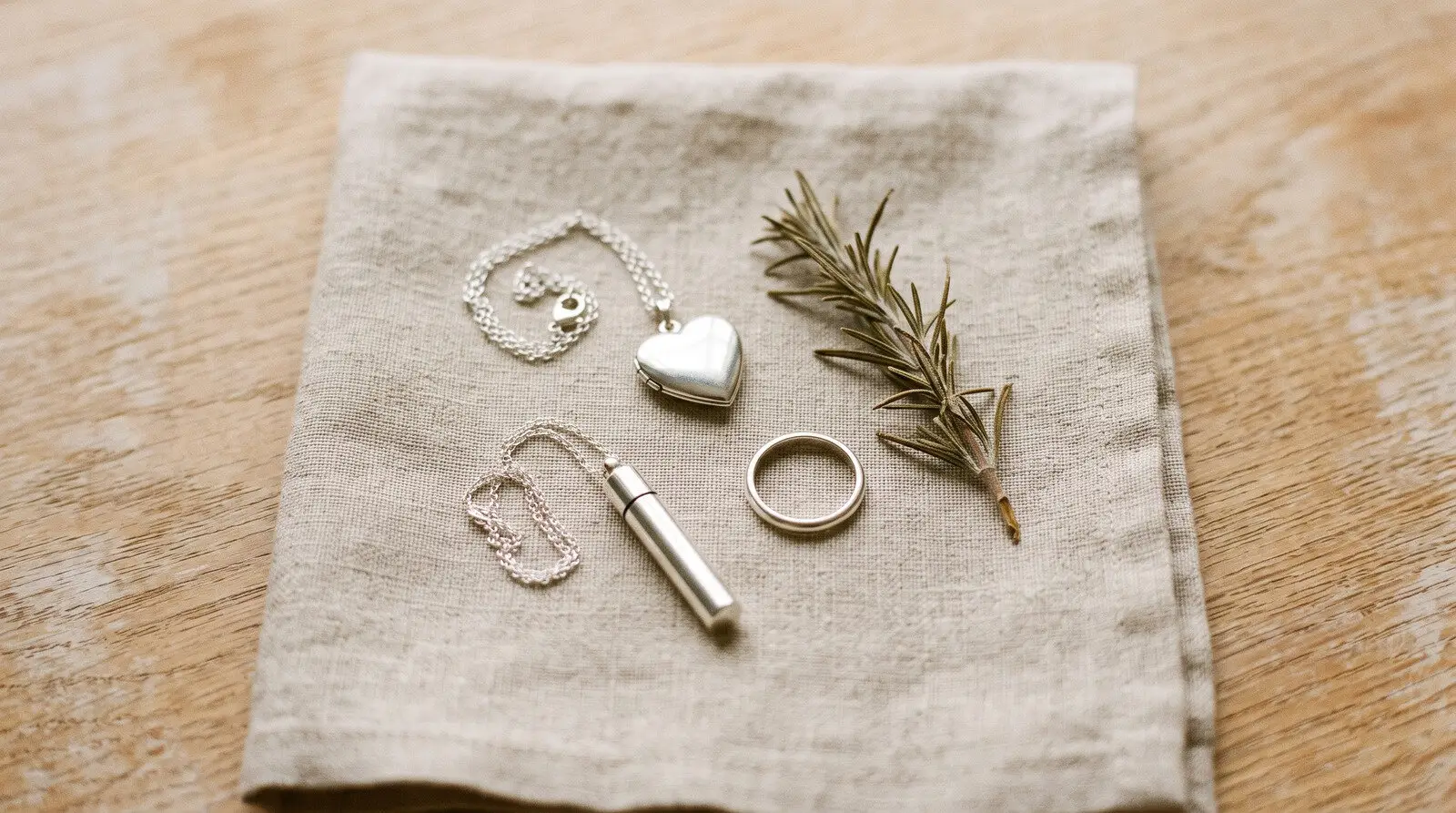
The most common piece sold, and the one most people mean by "cremation jewelry." A small hollow pendant — a cylinder, a heart, a teardrop, a cross — with a threaded screw at one end. You place a small quantity of ash inside, usually less than a quarter teaspoon, and seal it.
Why choose it. It does the thing memorial jewelry is for. It also works well when ashes are being divided among several people, since each pendant needs almost nothing.
What to watch.
- Ask what it is made of. Stainless steel and sterling silver both wear well. Plated base metal will flake within a year or two, and you do not want to be re-buying this.
- Seal it properly. Most come with a small funnel and a tiny screw. Reputable makers recommend a drop of jeweler's adhesive on the thread. Do the filling over a sheet of paper, not over a sink or carpet.
- Do not fill it as the only copy. Keep the remainder of the ashes elsewhere. Pendants get lost, and a lost pendant should be a sad day, not an irreversible one.
- Ask about a replacement policy before you order, for the same reason.
Some funeral homes will fill and seal a pendant for you. If handling ashes yourself feels impossible, ask — it is a routine request.
3. Fingerprint and Handwriting Jewelry — $80–$500
A fingerprint pressed into silver or gold, or a signature and a few words in their handwriting reproduced onto a bar or a disc. The impression is usually taken by the funeral home before cremation or burial; handwriting can be scanned from any card, note or letter you still have.
Why choose it. It is unmistakably personal without containing remains. A signature from a birthday card, in their actual hand, on a piece you wear — many people find this more affecting than ashes, and it removes the discomfort some feel about carrying them.
What to watch. Fingerprints must be captured within a short window, so it is one of the few decisions that has a deadline and is worth raising with the funeral director early. If nobody took a print, handwriting is still available — look in cards, recipe boxes and the backs of photographs.
4. Hair and Lock Jewelry — $100–$600
A lock of hair set under glass, woven, or encased in resin inside a pendant or a ring. This is genuinely old — Victorian mourning jewelry was often hair work — and it has come back, partly through pet memorials, where it is now one of the most-requested forms.
Why choose it. Hair can be collected long before it is needed, which makes this the one type that also works for the living: a grandparent's lock while they are still here, or a first haircut. It does not require cremation, so it is available to families who bury.
What to watch. Sealing quality decides everything. A poorly sealed piece admits moisture and the hair discolours. Ask specifically how it is sealed and whether the maker will re-seal it later.
5. Ash-Infused Glass and Resin — $150–$800
A glassblower or resin artist suspends a small amount of ash in the material itself, producing swirls and clouding that are different in every piece. Sold as pendants, beads, ring stones, and small sculptural objects that are not worn at all.
Why choose it. Colour and singularity. Nobody else has yours, and it does not read as funeral goods — most people seeing it will think it is simply a nice pendant, which some wearers want very much.
What to watch. Ash is visible as clouding rather than as recognizable particles; if you are expecting to see something specific, you will be disappointed. Quality varies more here than anywhere else on this list because it is largely small independent makers. Look for photographs of finished pieces made from other people's ashes, not renders, and read what happens if a piece breaks in the kiln — a good maker tells you up front and asks for slightly more ash than needed.
6. Cremation Gemstones and Diamonds — $1,500 to $20,000 and Up
Laboratories extract carbon from cremated remains or from hair, and grow a gemstone from it over a period of months. The result is a real lab-grown stone that can be set into a ring or pendant. Colour, size and cut drive the price, and the range is enormous.
Why choose it. It is the one piece intended to be inherited rather than worn out. Families who want a single object to pass down, rather than six small ones to distribute, sometimes decide this is where the memorial budget goes.
What to watch.
- Turnaround is measured in months, sometimes many. Do not order this expecting to wear it to the funeral.
- Ask for documentation — a certificate identifying the stone, and a written chain of custody for the remains. Reputable labs provide both without being asked.
- Ask how much ash is required and what is returned. Requirements vary considerably.
- This is a large purchase made under grief, which is the condition under which people most reliably overspend. If it still seems right in three months, it is right. The ashes are not going anywhere.
Before You Order Anything
A short list that applies regardless of type:
Agree with the family first. Dividing ashes is not reversible, and doing it before everyone has been asked is one of the more durable ways to cause a rift. Several traditions — Catholic practice among them, and Islamic and Orthodox Jewish law, which do not permit cremation at all — have real positions here. Ask rather than assume. If ashes turn out to be off the table, types 1, 3 and 4 need none.
Order one piece before ordering six. Photographs on these sites are heavily lit and often larger than life size. See the real thing before committing the whole family.
Check the metal, not the picture. "Silver-tone" and "silver-plated" are not silver.
Keep the receipt and the maker's name somewhere findable. In fifteen years, someone will want a repair, a re-seal, or a matching piece, and the small studio may or may not still exist under the same name.
If you have not yet decided what happens to the ashes overall, the jewelry decision sits inside that larger one — the options for ashes are worth reading first, because scattering and keepsake jewelry can both happen, but only if a portion is set aside before the scattering.
When Jewelry Is Not the Answer
Sometimes the impulse behind the search is not really about wearing something. It is about wanting the person to be present in daily life, and jewelry is simply the first thing that comes up when you search for that.
Other things do the same job differently: a recipe cooked on the same date each year, a bench, a donation made annually, a page of photographs and stories that other people keep adding to. A range of them here, and what families tend to do on the first anniversary — worth reading before spending, if only because it clarifies what you are actually looking for.
Frequently Asked Questions
How much ash does an urn pendant hold? Very little — typically under a quarter teaspoon. Filling a dozen pendants for a family uses a negligible fraction of the remains.
Can I fill it myself? Yes, and most pendants ship with a funnel for exactly that. Work over paper in a room with no draught, take your time, and seal the thread with a drop of adhesive. Many funeral homes will do it if you would rather not.
Is memorial jewelry allowed on a flight? A sealed pendant containing a small amount of ash is generally treated as a personal item and is not usually an issue. Carrying a full urn is a different matter with its own rules — check the airline and the destination country in advance.
What if I lose it? Which is why you never put the only remains into a single piece. Keep the remainder, ask about the maker's replacement terms before buying, and consider having two made if the piece will be worn daily.
Does memorial jewelry work for pets? Yes, and it is one of the largest parts of this market. Hair and fur jewelry in particular is common, and does not require cremation.
GetMemorial helps families build beautiful, lasting online memorials in minutes — a permanent home for photos, tributes, and stories. Make a free online memorial for someone you love.