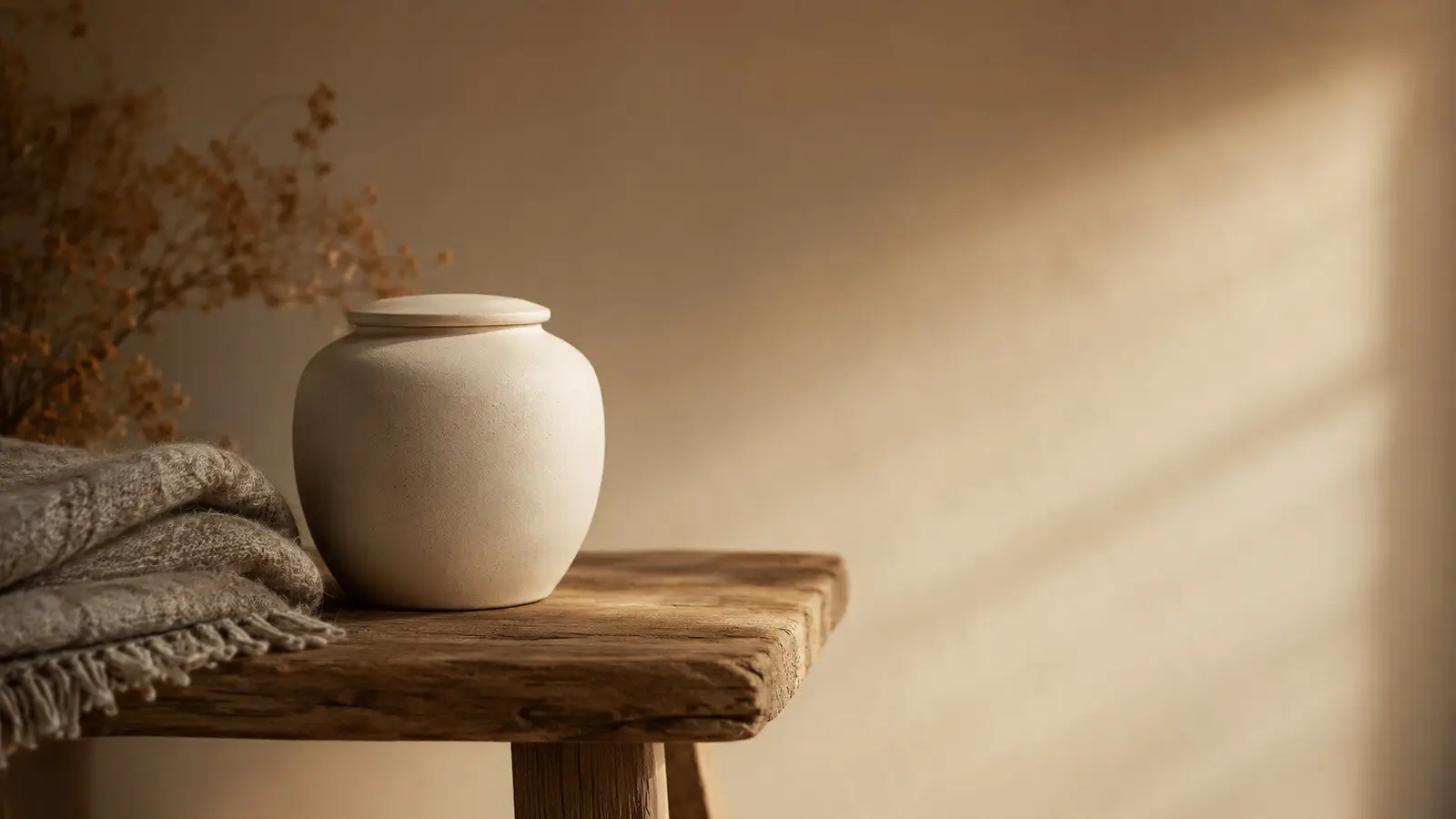
What to Do With Ashes: Your Options, and Why There's No Rush
The box is in a cupboard. Or on top of a wardrobe, or in the boot of the car where you put it after the crematorium and never quite dealt with. It has been there for months, possibly years, and every time you notice it you feel a small guilt about not having decided anything.
Almost everyone who has been handed a set of ashes has felt exactly this. So before the options: there is no deadline, and the cupboard is a legitimate place for them to be while you work out what you want.
There Is Genuinely No Rush
Nothing expires. Cremated remains are inert — sterile, stable, and unchanged whether they sit for a week or a decade. No health rule, no legal clock, no crematorium policy requires you to do anything by any date.
Funeral directors will hold them for you if you would rather not have them in the house. Many families collect them years later. Some never scatter them at all, and pass them down instead.
What people regret is not waiting. It is the opposite — scattering in the first raw weeks because it felt like the thing to do, in a place chosen under pressure, and finding later that they wanted somewhere else. Like sorting a loved one's belongings, this is a decision that gets better with distance, and it is one of the few in the whole process that is genuinely irreversible.
If you are still in the first weeks and the paperwork is what is overwhelming you, the first days after a death covers the things that actually do have deadlines. This is not one of them.
What You Actually Have
People are often unprepared for the physical reality, and knowing in advance takes some of the shock out of the first time you open the container.
They are not ash. Soft tissue burns away entirely; what remains is bone, processed into coarse fragments. The texture is closer to crushed shell or coarse sand than to fireplace ash, and the colour is pale grey-white rather than black.
There is more than you expect. An adult typically leaves somewhere around 4 to 6 pounds — roughly 2 to 3 kilograms — and a standard urn holds about 200 cubic inches. This surprises people at the scattering, when a handful turns out to be heavier and to fall faster than they imagined.
The container you were given is temporary. Crematoria usually hand over a plain plastic or cardboard box. It is not the urn; it is packaging. You are free to transfer them into anything you like, or to leave them exactly as they are.
You can divide them. This is worth knowing early, because families often assume they have to pick one thing. You do not. Some can be scattered, some buried, some kept, some given to a sibling in another country. Dividing is common, entirely permitted, and often the answer when nobody can agree.
Option One: Scattering
The most chosen option, and the one with the most rules attached.
The rules vary by country and often by state or region, so treat the following as the shape of the thing rather than a checklist — and verify locally before you commit to a date.
On private land: you need the landowner's permission. Your own garden is straightforward, though it is worth thinking about whether you might move house.
On public land: parks, beaches, hills and beauty spots usually require permission from whoever manages the land. Many national parks issue permits for exactly this and will tell you where is and is not acceptable. Some famous locations receive so many requests that they have formal policies; a few well-known places prohibit it outright and it happens anyway.
In rivers and lakes: generally permitted with care. The usual guidance is to avoid scattering near where drinking water is drawn, to stay away from marinas and still water, and to remove anything non-biodegradable — wreaths, plastic, jewellery — before you scatter.
At sea: in US waters, the EPA requires scattering to take place at least three nautical miles from land, which means from a boat rather than a pier or beach, and you must file a reporting form within 30 days. It is a notification, not a permit — you do not wait for approval. Any container going into the water must be biodegradable and must not float.
The Practical Part Nobody Warns You About
Check the wind, and stand with your back to it. This is the single most useful sentence in this article. Ashes are fine enough to carry and heavy enough to fall fast, and scattering into a breeze is a well-known, awful, and entirely avoidable experience. Pour low and downwind, close to the ground or the water.
Pour rather than throw. A sweeping arm scatters them further than you want and looks less deliberate than it feels.
Rain helps. Damp ground settles them immediately instead of leaving a visible patch of pale grey.
Practise opening the container beforehand. Some have inner bags with cable ties or screw fittings that are awkward to open, and the graveside is a bad place to discover this.
Decide in advance who does it. If several people want to take part, divide the ashes into separate small containers first so nobody has to pass a heavy box around.
Option Two: Burial
Less discussed than scattering and worth considering, because it gives you what scattering does not: a fixed place to return to.
- A cemetery plot, either their own or in an existing family grave. Most cemeteries have a section for cremated remains at a fraction of the cost of a full burial plot.
- A garden of remembrance at the crematorium, often with the option of a small plaque.
- Your own garden, which is generally permitted on land you own — with the same caveat about moving.
- A woodland or natural burial ground, where a biodegradable urn is buried and a tree planted over it.
The argument for burial is one people tend to make years afterwards: scattering feels right at the time, but some find they later want somewhere specific to go on a birthday or an anniversary. Air and water do not give you that. A named place does.
Option Three: Keeping Them
Entirely normal, and more common than most people realise. There is no rule against keeping ashes at home indefinitely, and no reason to feel morbid about it.
If you keep them, the thing worth doing is choosing where deliberately. A cupboard by default has a slightly furtive quality that people say they dislike; the same ashes on a shelf you chose, in a container you chose, feel completely different. It is the same object and an entirely different relationship to it.
Two practical notes. Tell someone where they are and what you want done with them eventually — ashes with no explanation are a difficult thing for a family to inherit. And if you keep only part and scatter the rest, decide which part goes where before the day rather than during it.
Option Four: Made Into Something
A growing set of options that turn ashes into an object. All are real services, and prices vary enormously.
- Jewellery — a small quantity sealed into a pendant or ring, with the rest scattered or buried.
- Glass — ashes suspended in blown glass as a paperweight, ornament or bead.
- A tree — a biodegradable urn designed to have a sapling planted directly over it.
- A reef — remains mixed into a cast concrete form placed on the seabed as an artificial reef.
- A diamond — carbon extracted and grown into a stone over several months. The most expensive by a wide margin.
- Tattoo ink — a very small amount mixed into ink. Some artists will, many will not, and it carries a genuine infection risk that a reputable studio will discuss with you honestly.
These pair well with dividing: a pendant for one person, a tree for the family, and the rest scattered somewhere that mattered.
When the Family Cannot Agree
This is the hardest version, and it is usually not really about the ashes.
Legally, in most places the decision falls to whoever arranged the cremation — often the executor or the next of kin. That resolves who can decide. It rarely resolves the argument, because the argument is normally about who was closest, who was there at the end, and who feels least consulted.
Two things help more than a ruling:
Divide them. It sounds like a compromise and often turns out to be the actual answer. Two people wanting two different places can both have what they want, and nobody has to lose.
Wait. Positions that are absolute at three months are frequently negotiable at a year. Since there is no deadline, delay costs nothing and is one of the few situations where it reliably improves the outcome.
If You Need to Travel With Them
Common when family is spread across countries, and less difficult than people fear.
Flying: in the US, the TSA requires the container to be one that can be X-rayed — a wooden, plastic or cardboard container passes; a solid metal or stone urn may not, and officers will not open a container to inspect it. Carry them in hand luggage where the airline allows it, and carry paperwork: the death certificate and the certificate of cremation.
Internationally: rules vary and some countries require documentation in advance. Check the destination's requirements before you book, not at the airport. Your funeral director can usually tell you what a specific country wants.
The Part That Is Actually Difficult
None of the above is the reason the box has been in the cupboard for a year.
The reason is that deciding feels like a second ending. While the ashes are unscattered, something is still unfinished, and unfinished is closer to the person than finished is. Choosing a place and letting them go is the last practical act of the whole thing, and people put it off for reasons that have nothing to do with logistics.
That is worth naming, because once you have named it the delay stops being avoidance and becomes a choice. Wait a year. Wait five. But wait deliberately, rather than because the cupboard is easier than the thought.
And whichever you choose, the ashes were never the part that held the memory. What holds it is the specific detail — the phrase they always used, how they answered the phone, the story only one cousin remembers — and those fade far faster than a box in a cupboard does. There are other ways to keep someone present that do not depend on where the ashes end up, and they are worth starting long before you decide.
FAQ
How long can I keep ashes before doing something with them? Indefinitely. There is no time limit anywhere, and no health or legal reason to act by a particular date. Many families keep them for years; some never scatter at all.
Can I split ashes between family members? Yes, and it is common. Any funeral director will divide them into separate containers for you, or you can do it yourself. Splitting is often the cleanest answer when relatives want different things.
Do I need permission to scatter ashes? On private land, from the landowner. On public land — parks, beaches, hills — usually from whoever manages the site, and many issue permits for it. Rules differ by country and often by region, so check locally before fixing a date.
Is it legal to scatter ashes at sea? Generally yes, with conditions. In US waters the EPA requires at least three nautical miles from shore and a reporting form filed within 30 days, and any container must be biodegradable and must not float. Other countries have their own rules, usually similar in shape.
Can I bury ashes in my own garden? Usually yes, on land you own. The consideration people raise afterwards is moving house — a grave you cannot visit is worse than no grave, so think about whether you expect to stay.
Can I take ashes on a plane? Yes. Use a container that can be X-rayed — wood, plastic or cardboard rather than solid metal or stone — and carry the death certificate and certificate of cremation. Check international requirements before you travel, as some countries want documentation arranged in advance.
What if we scattered them somewhere and I regret it? This happens, and it is one of the reasons to wait. If it has already happened, the place is still the place — many people mark it another way instead: a bench, a tree, a plaque, or a date they return on each year.
GetMemorial helps families build beautiful, lasting online memorials in minutes — a permanent home for the photos, stories and details that outlast any decision about where the ashes go. Build yours at GetMemorial.com.