Grieving at Christmas: How to Get Through the Whole Season
Christmas is not one difficult day. That is what makes it different from every other anniversary in the grieving year.
A birthday is a date. Christmas is a season — six weeks of build-up that starts in November, saturates every shop, radio station and advert, and does not let you forget what is coming. Then the day itself, and then New Year arriving four days later before you have recovered.
If you are facing your first one, the useful thing to understand is that you are planning for a stretch of weeks, not for the 25th.
The Season Starts Long Before the Day
The lights go up. The songs start in shops. Someone asks what you are doing this year. A card arrives addressed to both of you.
These are the ambushes, and there will be many of them. Most people find the run-up genuinely harder than Christmas Day, because it lasts longer and because the reminders arrive when you are not braced.
A few things reduce the surface area:
Shop online. The supermarket in December, with the music and the crowds and the couples arguing over sprouts, is a bad place to be ambushed. Delivery is worth the fee this year.
Warn people early about cards. A short message in November — "we're having a quiet one this year" — saves you a dozen cards addressed to a household that no longer exists.
Skip what you can skip. The work party, the neighbours' drinks, the carol service you have gone to every year. Turning down three invitations is not a personality change. It is one December.
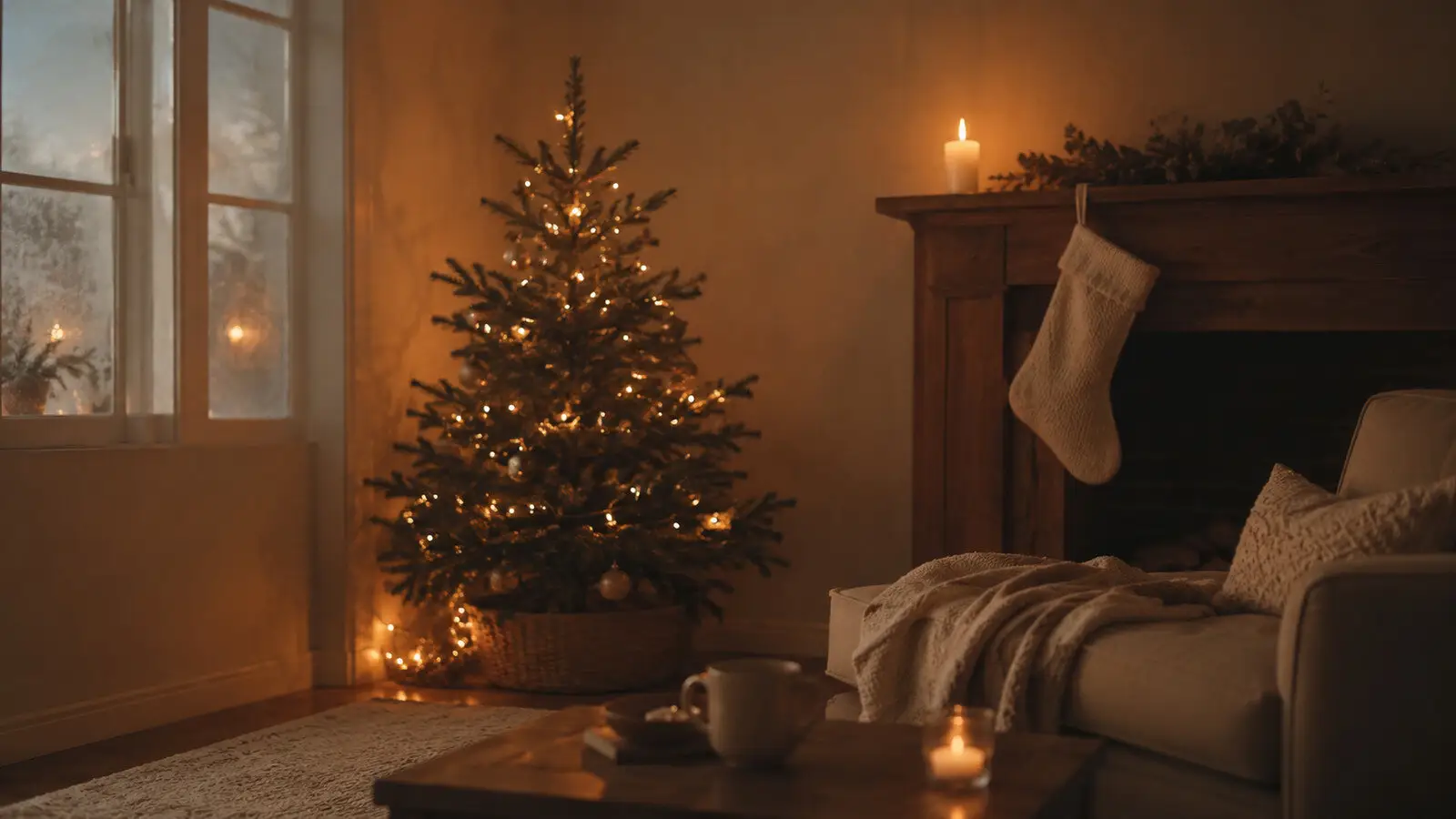
The Tree, the Stocking, the Decorations
The box of decorations is where a lot of people come unstuck, because it is full of specific objects with specific memories attached — the ornament they made, the one you bought on that holiday, the stocking with their name on it.
There is no correct answer here, only common ones:
- Do it all as normal. For some families the ritual is exactly the comfort, and skipping it makes the house feel worse.
- Do less. A smaller tree, fewer decorations, or the tree without the personal ornaments.
- Do it differently. Different colours, a different room, a new tree entirely. Removing the direct comparison to last year is often what makes it bearable, rather than the decorating itself.
- Skip it. One year without a tree is one year without a tree.
On the stocking or the named ornament specifically: some families hang it anyway, some put a note or a photograph inside it, some pack it away with everything else. If you are hanging it, tell people beforehand rather than letting them walk into it.
Whatever you decide, open the decoration box early and alone if you can. Do the crying in November, on your own terms, rather than in front of the children on a Sunday afternoon.
The Gift You Already Bought
This comes up more than you would expect, and it is worse than people anticipate. Something bought in October. Something they ordered that arrives in December. A present they had already wrapped and hidden.
What people do with it: give it to someone who would have liked it. Keep it unopened. Donate it. Open it on the day and let it be what it is.
There is no wrong answer, but do not leave it to the morning. Deciding in advance means it does not detonate in the middle of the day.
Their gift to you, if you find one, is a different matter. Most people open it, and most are glad they did, even though it is hard. But if you are not ready this year, it will keep.
Christmas Day Itself
Make the decisions in advance rather than on the morning. Who is coming, where, what time, who cooks, whether their place is set, whether anyone says something.
Beyond that, three things worth planning:
A way to include them. A candle on the table. A toast before the meal — one sentence is plenty, and what to say matters less than saying anything at all. Their dish, cooked by someone. Playing the album they always put on. The alternative, where everyone thinks about the same person and nobody says their name, makes the room heavier rather than lighter.
Something to do with the middle of the day. Christmas afternoon is long and unstructured, and that is when the absence gets loud. A walk, a film, a job, a visit to somewhere they liked. Something with a shape.
A way out. Drive separately. Decide in advance you might leave after lunch. Tell one person you might need twenty minutes upstairs. Knowing you can leave usually means you do not have to.
Children Change the Calculation
If there are children, you will feel pressure to produce a normal Christmas, and that pressure is not entirely wrong — children do better with the structure kept.
But "normal" does not mean pretending. Children generally cope better with a parent who is visibly sad and present than with one performing fine, because the performance teaches them that grief is something to hide. Saying "I'm sad today because I miss Grandad, and I'm still glad we're doing this" is a more useful thing for them to see.
Practical version: keep the shape of the day, lower the standard. Fewer presents, simpler food, a film instead of an outing. Nobody is grading this.
Then New Year, Four Days Later
This is the part people are least prepared for.
New Year is structurally cruel to the newly bereaved. It draws a line and puts the person on the other side of it — the last year they were alive, and now a year they will never be in. Everyone else is talking about fresh starts.
It is also, for many people, quieter and lonelier than Christmas, because the family gathering has dispersed and everyone has gone home.
Plan for it separately. Do not assume that getting through the 25th means you are through. Some people deliberately make no plans and stay in; some make a specific plan with one person; some go to bed before midnight on purpose. All of these are reasonable. We wrote about that night on its own in the new year after a loss.
If This Is Not Your First Christmas
The second is sometimes harder than the first. In the first year you are numb and everyone is watching out for you. By the second, the shock has worn off, the permanence has landed, and the world has moved on and expects you to have moved with it.
If that is where you are: it is not a relapse and you are not doing this wrong. It is an extremely common pattern that almost nobody warns people about.
What Usually Happens Next
Most families find the traditions come back gradually and in altered form. Some things return exactly as they were. Some are gone for good. Something new starts that has no relationship to how it used to be.
You are not deciding this year what Christmas looks like for the rest of your life. You are getting through one December, in whatever way costs you least.
For the general version of this — any first holiday, not just Christmas — we wrote about the first holiday without them.
FAQ
Should we cancel Christmas entirely? It is a legitimate option, and some families do it for the first year — going away, or treating it as an ordinary day. The version that tends to go badly is not deciding, and arriving at the 25th with everyone assuming something different.
How do I handle people wishing me a merry Christmas? Have a short reply ready and reuse it. "Thanks, you too — it's a quiet one for us this year." It closes the exchange kindly without inviting a conversation you may not want in a shop queue.
Everyone in my family wants something different. What now? Say it out loud rather than negotiating in hints, and split the day if you have to — morning at one house, afternoon at another. Nobody gets everything they wanted; everyone gets some of it. That beats one person silently carrying a day they cannot face.
Is it wrong to enjoy it? No. An hour of genuine enjoyment is not a verdict on how much you loved them. Most people get ambushed by a good moment and feel guilty afterwards — the guilt is nearly universal and it is not evidence of anything.
What do I do about the empty chair at the table? Both answers are common: set the place, or reconfigure the table so there is no gap to look at. The only version that goes badly is the one nobody discussed, where someone is blindsided. Ask beforehand.
GetMemorial helps families build beautiful, lasting online memorials in minutes — a permanent home for photos, stories, and the traditions worth keeping. Make a free online memorial for someone you love.