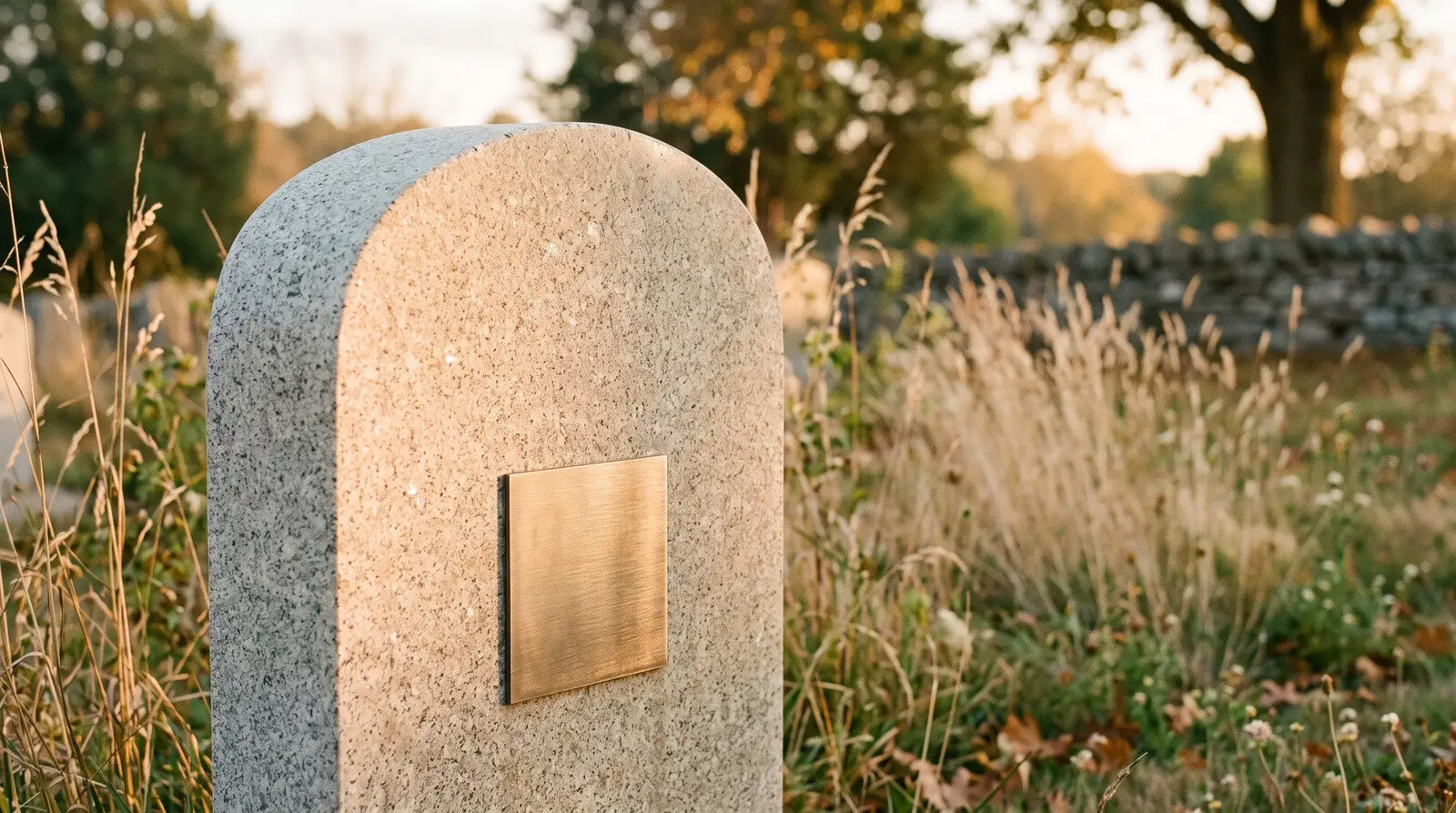
QR Code Headstones: How They Work, What They Cost, and the One Way They Fail
A headstone gives you a name, two dates and maybe six words. That is the whole biography, carved to last four hundred years.
A QR code on the same stone gives you the rest of it — photographs, the obituary, the eulogy somebody spent a week writing, voices, the reason the six words were chosen. Someone stands at the grave, points a phone at a small square, and a life opens up.
It works. Cemeteries across the US, UK and Australia have them now, and the technology is unremarkable — a QR code is just a web address written in a form a camera can read. But there is a mismatch at the heart of the idea that most vendors will not bring up, and it is worth understanding before you spend anything.
How It Actually Works
Three pieces, and only three.
A web page. Somewhere online there is a page about the person — photos, life story, tributes. It has a fixed address.
A QR code. That address, encoded as a pattern of squares. You generate it in about ten seconds with any free QR generator; there is no licensing and nobody owns the format.
A physical carrier. The code, reproduced on something that survives outdoors and attaches to the marker.
That is all. A QR code is not a chip, does not transmit anything, needs no power, and has no expiry date of its own. It is a printed URL. Everything about how long it works depends on the page it points at — which is the whole problem, and we will come back to it.
Modern iPhone and Android camera apps read QR codes natively, so a visitor does not need to install anything. That was not true a decade ago and it is the main reason these have become practical.
What Goes on the Stone
You have four realistic options, and they are not equally good.
Ceramic or porcelain tile. The code is fired into a glazed tile, usually 1 to 2 inches square. This is the most common choice and generally the most durable — glazed ceramic is what memorial photo plaques have used for over a century, and it does not fade in sunlight. Attached with monument epoxy.
Stainless steel or anodised aluminium. Laser-etched or printed on metal. Very durable, slightly more modern in appearance, sometimes screwed rather than glued.
Engraved directly into the granite. Appealing in theory — nothing to fall off, nothing to add. In practice it is the least reliable, because QR scanning depends on contrast between the dark and light modules, and grey-on-grey engraved stone often has very little. If a mason offers this, ask to scan a finished example on a dull day before committing, and ask whether they infill the engraving with a contrasting colour.
Printed vinyl or laminated stickers. Cheap, and they are the reason some people think QR headstones do not last. UV and freeze-thaw destroy them within a few seasons. Fine as a temporary marker while a permanent stone is being made; not fine as the permanent solution.
Physical size matters more than people expect. A code needs enough physical area for a phone to resolve it at arm's length — roughly an inch square is the practical floor, and larger is more forgiving in poor light. Keep the plain border around the code; cropping it tight is a common way to make a code that scans in the workshop and fails in the rain.
Cost, Realistically
Two separate costs, and vendors often quote only the first.
The plaque. Ceramic or metal QR plaques are generally in the low tens of dollars to around a hundred, depending on material, size and whether the vendor is a monument company or a dedicated QR memorial service. Prices vary widely enough that it is worth getting two quotes.
The page it points to. This is the one that runs forever, and it is priced in three different ways across the industry:
- Ongoing subscription — monthly or yearly, indefinitely. Cheapest to start, and it is the model that fails first, because it fails the moment somebody stops paying.
- One-time fee for permanent hosting — you pay once, the provider commits to keeping the page up. Better, and only as good as the provider.
- Free tier — the page costs nothing. Also only as good as the provider, but at least nothing lapses through an expired credit card.
We compared how the main services structure this in our memorial website cost comparison. The relevant question here is not which is cheapest. It is which will still answer a request in 2060.
The Way These Fail
Granite lasts centuries. Websites last about six years.
That is the whole risk, stated plainly. A QR code carved into a memorial is a permanent physical pointer to an impermanent digital thing. When the company behind the page shuts down, is acquired, or simply lets the domain lapse, the code does not stop working — it keeps working perfectly, and delivers a 404, or worse, whatever the domain got resold to. There is a genuine and grim version of this where a grave marker scans through to a parked advertising page.
Nothing about the QR format prevents this. The code is just ink. Four things reduce the risk:
1. Use a dynamic code, not a static one. A static QR has the final URL baked into the pattern — change providers and the stone is wrong forever. A dynamic QR points to a short redirect link that you can repoint later. The catch is that you have then added a second company that has to survive, so only use a redirect service you would trust as much as the memorial host itself. If you own a domain, the safest dynamic code is a redirect on your own domain.
2. Prefer a provider with permanent, no-payment-required hosting. Anything that depends on someone continuing to pay a monthly fee has a defined lifespan, and it is roughly the lifespan of the person who set up the payment.
3. Keep your own copy of everything. Every photograph, the obituary, the recordings, on a drive somewhere in the family. If the service disappears, the memories should not. This is the single most important item on the list and it costs nothing.
4. Write the URL on the stone as well as the code. In plain readable text, small, beneath the code. A human can type a web address; a human cannot type a QR code. It also means the marker still tells you something if QR readers ever go the way of the fax machine.
We wrote separately about what "permanent" actually means when a memorial site claims it, because the word is used very loosely and the difference matters more here than anywhere else.
Before You Order: Ask the Cemetery
This is the step people skip and then regret.
Most cemeteries have written rules about what can be attached to a monument. Some prohibit anything adhered to the stone outright. Some require the monument company to do the work. Some allow it only on the base, not the face. Some have no rule but will develop one if you ask, so ask the office and get the answer in writing before ordering anything.
Also worth asking:
- Whether the marker is owned by the cemetery (common with flat lawn markers and in veterans' sections, where alterations are usually not permitted).
- Whether there is mobile signal at the plot. Rural cemeteries frequently have none, and a code that cannot load a page is decoration. If signal is poor, this may not be worth doing at that location — or the page needs to be very light to load on one bar.
- Who to notify so groundskeepers do not treat the plaque as debris.
If the burial has not happened yet and these questions are landing on top of everything else, the practical checklist for the first weeks may be a better place to start; the QR plaque can be added to a finished stone at any point later.
What to Put on the Page
The visitor is standing outdoors, possibly in the wind, on a phone, on poor signal, and they have maybe ninety seconds. Design for that.
Above the fold: the photograph, the full name, the dates, and two or three sentences that say who this person was. Not the full obituary — the two sentences you would say if someone asked at the graveside.
Below that: the obituary, the eulogy, a photo gallery, and anything recorded in their voice. Audio is the thing people underestimate. A voicemail nobody could bring themselves to delete becomes, in this context, the most valuable file in the family.
At the bottom: a way for visitors to add something. Someone who visits a grave in 2041 and remembers a story about the person should be able to leave it there. That is the part a headstone can never do, and it is the actual argument for the whole exercise.
Keep the page fast and keep it light. A gallery of forty full-resolution photographs will not load in a cemetery with one bar of signal, and the visitor will put the phone away.
If you are also choosing the carved inscription, these headstone quotes and what to write on a memorial plaque cover the words themselves.
Beyond Headstones
The same three pieces work anywhere a physical object should point at a story:
- Memorial benches — a small plaque on the armrest, often easier to permit than a cemetery attachment.
- The back of the funeral programme, so people can find the page later without having to ask.
- Memorial trees and garden markers.
- Urns and keepsake boxes, engraved on the base.
- Inside a family photo album, on the first page.
The programme is the one worth doing first if you only do one. It reaches everyone who attended, on the single day they are all thinking about the person, and it costs one square inch of ink on something you were printing anyway.
Is It Worth Doing?
Yes, with one condition attached.
It is worth doing if you treat the web page as the memorial and the stone as the signpost, rather than the reverse. Families who get this right choose the hosting first, on the basis of who is likeliest to still exist in thirty years, and order the plaque second. Families who get it wrong choose a plaque from a monument catalogue, accept whatever hosting comes bundled with it, and discover in eight years that the code goes nowhere.
The stone is the durable part of the arrangement and the website is the fragile part, which is the exact opposite of how it feels when you are ordering. Plan around that and it is one of the better ideas in modern memorialisation.
Common Questions
Do QR codes on headstones expire? The code itself never expires — it is a printed web address. The website it points to can, which is the entire risk.
Do visitors need to download an app? No. iPhone and Android camera apps read QR codes natively.
Will the code still scan after ten years outdoors? Fired ceramic and etched metal, yes. Printed vinyl stickers, no — those fail within a few seasons.
Can you change where the code points after it is installed? Only if you used a dynamic code — one pointing at a redirect you control. A static code is permanent.
Do cemeteries allow QR plaques? Many do, some do not, and the rules are specific. Ask the cemetery office in writing before ordering.
What if there is no mobile signal at the grave? The code will not load anything. Check signal at the actual plot before committing, and keep the page light if it is weak.
Can you add one to an existing headstone? Yes. The plaques are designed to attach to finished stone, though the cemetery may require their approved monument company to do it.
GetMemorial helps families build beautiful, lasting online memorials in minutes — a permanent home for tributes, photos, and stories. Every memorial has its own web address, which is all a QR plaque needs. Build a digital memorial that stays online for good.