How to Preserve a Loved One's Voice (Before and After They're Gone)
The photographs survive. People are careful with photographs.
The voice is the thing that goes, and almost nobody notices until they try to remember it and cannot. It happens faster than people expect — often inside two years. What tends to bring it back is not a memory but a recording: a saved voicemail, a birthday video where somebody is talking off camera, thirty seconds of an argument about a barbecue.
This is a guide to finding what you already have, keeping it somewhere it will not disappear, and — if there is still time — recording more.
Start With What Already Exists
Almost every family has more than they think. Before recording anything new, go looking. Set aside an evening; it is a slow job and it is not an easy one.
Voicemail. The most common surviving recording and the most fragile. Carriers delete saved voicemails on their own schedule, often after weeks, and the message vanishes when the account closes. On an iPhone, open a saved voicemail, tap share, and send it to yourself as a file. On Android it varies by carrier — if there is no share option, use the second method below. Do this today rather than this month.
Videos where nobody is the subject. Search your camera roll for events, not for the person. Christmas, a wedding, a hospital visit, somebody's garden. The best voice recordings are almost always accidental: they are behind the camera, commenting, laughing at something off-screen, telling everyone to stand closer together.
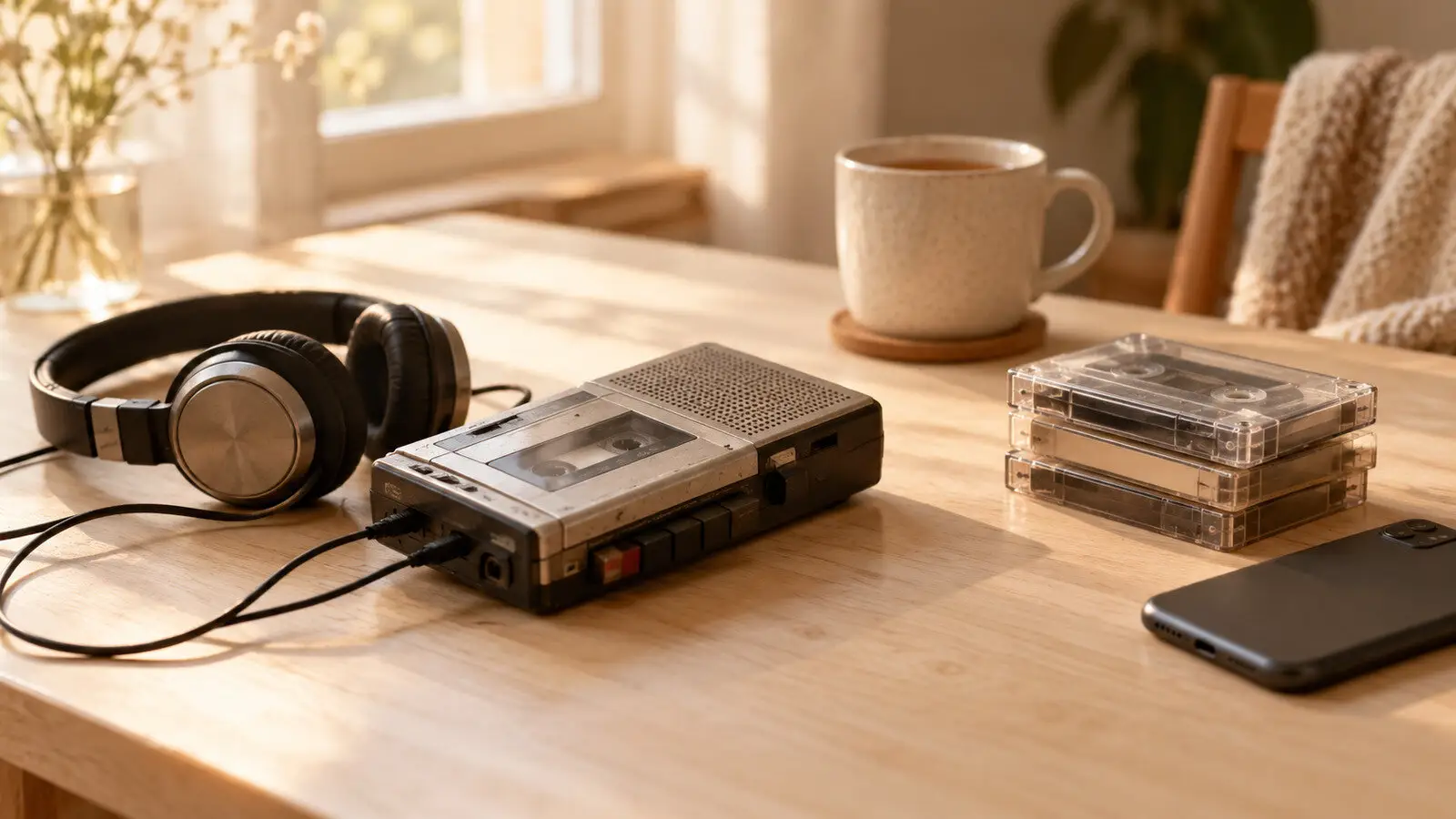
Old tapes. Camcorder cassettes, microcassettes from an answering machine, reel-to-reel. Local transfer services handle these and it is not expensive per tape. Do not attempt to play a thirty-year-old tape on a thirty-year-old machine to check whether it is worth transferring — that is how tapes get eaten.
Other people's phones. This is the one families skip and it is often the richest. Ask siblings, cousins, in-laws, old colleagues, the neighbour. Ask specifically: do you have any video or voice notes with Dad's voice in them, even in the background? The word background matters — people say no to "recordings of Dad" and then remember a video of their dog where he is talking the whole time.
Answering machines and old computers. Actual machines in cupboards, and .wav or .amr files on a decade-old laptop. Worth twenty minutes.
If There Is No Share Button: Record the Playback
The universal fallback. Play the message on one phone with the speaker on, and record it with a second phone's voice memo app, in a quiet room, six inches away.
The quality is worse. It does not matter. A slightly muffled copy of your mother saying your name is infinitely better than a perfect recording you no longer have access to, and the sound of the room around it is not really a flaw.
If There Is Still Time, Record Them
This is the hard section. If the person is alive and you are reading this, you already know why.
Do not announce that you are making a recording for after they die. It changes the register instantly and it is a cruel thing to make someone perform. Record ordinary conversation instead.
Ask about things, not about themselves. "Tell me about your life" produces a stiff summary. These produce a voice:
- How did you and Mum actually meet? Not the version you tell at parties.
- What was the house you grew up in like — start at the front door and walk me through it.
- Who taught you to cook this?
- What was the worst job you ever had?
- What did you think you were going to be?
- Tell me about your father.
- Sing the thing you used to sing to us.
Record the ordinary things too. How they answer the phone. The way they say goodbye. A recipe dictated in real time in their kitchen. Reading a book to a grandchild — that one gets played the most, years later, more than any interview.
Keep sessions short. Twenty minutes, more than once, beats a two-hour marathon that exhausts everyone and gets recorded once.
Use a phone. A modern phone's voice memo app is good enough. Put it on a folded tea towel to kill the table noise, keep it about a foot away, and turn off anything with a fan or a compressor in the room. Do not buy equipment. Buying equipment is how this gets postponed.
Ask permission, and say what it is for. "I want the grandchildren to be able to hear you" is true, kind, and usually welcomed. Many people are quietly glad to be asked.
Save It So It Actually Survives
A recording that exists in exactly one place is not saved. It is waiting.
Get it off the phone. Phones are lost, stolen, dropped and upgraded. The file needs to leave the device it was made on.
Three copies, two kinds of place, one somewhere else. One on a computer, one in cloud storage, one on an external drive or with another family member. This is the standard rule for anything irreplaceable and it exists because every other approach eventually fails.
Use plain formats. WAV or MP3 for audio, MP4 for video. Avoid anything that only opens in the app that made it — voicemail formats especially. Convert once, now, rather than discovering in 2035 that nothing will open it.
Name the files properly. Dad-voicemail-2024-03-birthday.mp3, not audio_0034.amr. Include who, when, and what. In ten years the person who needs this file may not be you, and an unnamed file is a file nobody plays.
Write down what is in it. A one-line note per recording — who is speaking, roughly when, what is happening. Whoever finds these later will not recognise the voices, and a folder of unlabelled audio is close to useless.
The same discipline applies to photographs and scanned documents; we set it out in more detail in how to digitize and restore old family photos.
Then Let People Hear It
Preserved and never played is only half the job. Recordings that sit on one person's hard drive get lost with that hard drive, and more to the point, nobody else gets them.
Put the good ones somewhere the family can reach — a memorial page, a shared album, anywhere that does not require asking you for a copy. Choose two or three rather than all forty; the thirty-second voicemail is the one people will play, not the ninety-minute interview.
Two notes on doing this well. Give each recording a line of context so people know what they are about to hear — answering the phone, about a month before he went into hospital — because voices catch people off guard. And think about who can access it: a voice is more intimate than a photograph, and some families want it kept to a private page rather than a public one.
How to make a tribute page covers the practical setup, and how to involve family in remembering covers getting relatives to contribute their own recordings rather than leaving it all to one person.
What Not to Do
Do not wait for a good moment. There is no good moment. The recording made in a noisy kitchen on a bad day is the one that exists.
Do not delete anything for being poor quality. Wind noise, a truck going past, a half-finished sentence — none of it matters in ten years. Delete nothing.
Do not clean it up too much. Noise reduction, aggressively applied, strips the room out and leaves the voice sounding synthetic. Keep the original file always, and treat any cleaned version as a second copy.
Do not use AI to generate more of their voice. Voice cloning from a recording is technically possible and there are products that will do it. Families who have tried it generally describe the same thing: it sounds like them and it is not them, and hearing it says something new is closer to a haunting than a comfort. Keep what they actually said.
FAQ
How much is enough? Less than you think. Thirty seconds of natural speech is enough to bring a voice back. People aim for hours, record nothing, and end up with a voicemail — which turns out to be plenty.
Can I recover a voicemail I already deleted? Sometimes, briefly. iPhones keep deleted voicemails in a "Deleted Messages" folder for a limited period, and some carriers can retrieve recently deleted messages if you call and ask quickly. Both windows are short. Check today.
What about voices in old home videos where the sound is bad? Transfer them anyway. Audio from degraded video is often more recoverable than the picture, and background conversation is exactly the kind of unguarded speech that is hardest to replace.
Is it morbid to record someone who is dying? Families who did it almost never regret it. Families who did not almost always do. Record conversation rather than a farewell, keep it short, and stop the moment they would rather you did.
What if I only have one recording and it is terrible? Then it is the most valuable file you own. Copy it three times, name it properly, and stop apologising for it.
GetMemorial helps families build beautiful, lasting online memorials in minutes — a permanent home for recordings, photos, and stories. Build a digital memorial that stays online for good.


