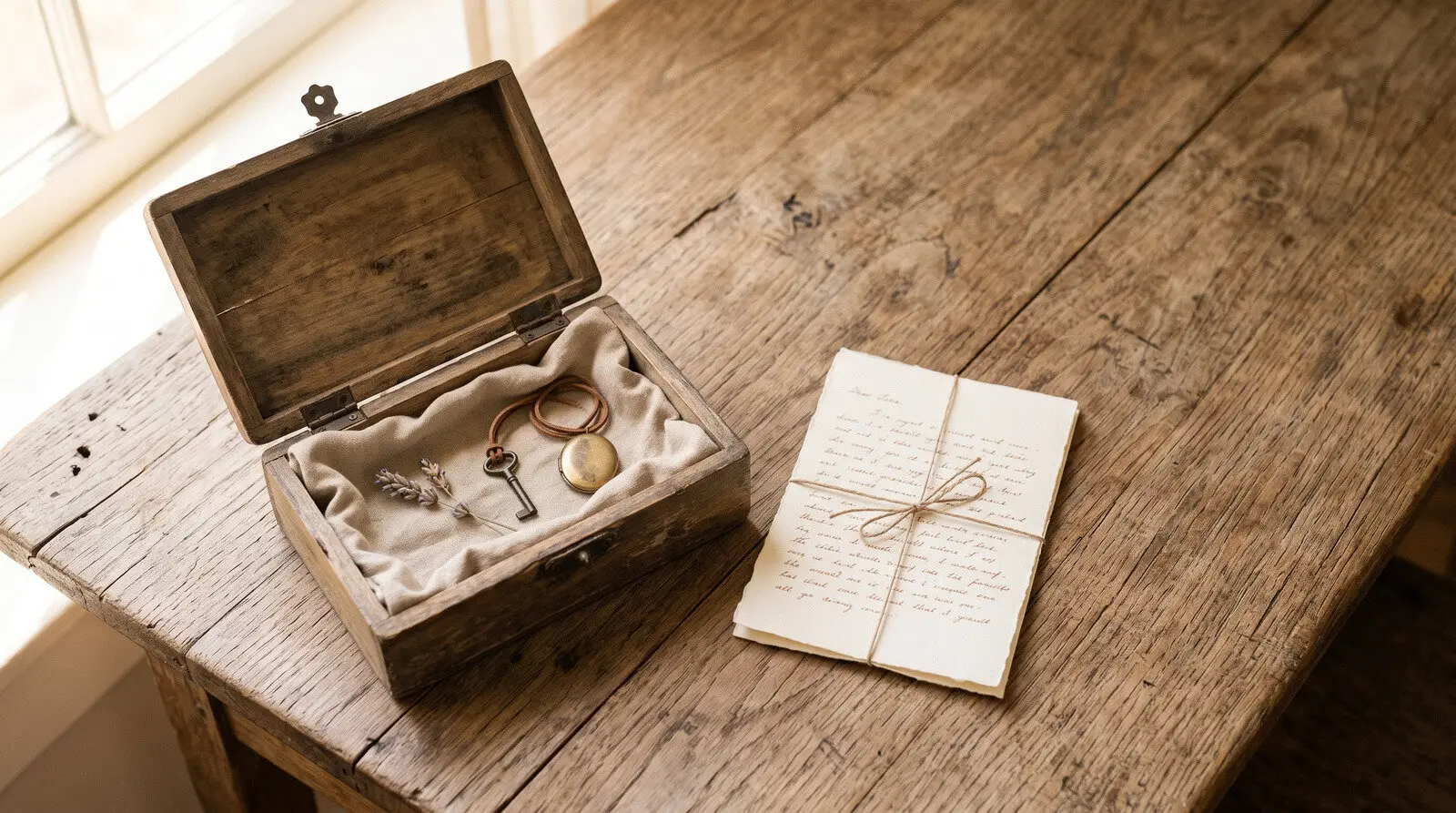
Memory Box Ideas: What to Put In One and How to Make It Last
A memory box is one of the few grief projects that asks almost nothing of you. There is no deadline, no audience, and no right way to do it. You put things in a box because you cannot bear to put them anywhere else, and because a drawer is not the same as a place.
Most people start one accidentally — a shoebox that fills up with the things nobody could decide about. Turning that shoebox into something deliberate takes an afternoon, and it changes what happens to it in twenty years.
What Goes In One
The instinct is to keep the important things. In practice, the objects that hold up best are the small and unremarkable ones — the ones that carry a gesture rather than a milestone.
Things in their handwriting. A shopping list, a birthday card, a note left on the counter, a recipe with a correction in the margin. Handwriting is the single most affecting thing most families keep, and shopping lists outperform formal letters almost every time.
Something that was worn or held daily. Reading glasses, a watch, a scarf, a wallet, a set of keys. Not the good jewellery — the object their hand went to without thinking.
One item of clothing, kept for its smell. It fades within a year or two even in a sealed bag. Knowing that in advance makes it easier later.
Photographs, but only a handful. A memory box is not an archive. Choose five or six prints, including at least one that is not posed. The full collection belongs somewhere it can be seen and shared — see how to digitize and restore old family photos for what to do with the rest.
Small documents. A passport, a ticket stub, a program from an event they cared about, a badge from work.
Something that makes a sound or smell. A bottle of their perfume or aftershave, a music box, a cassette. Smell reaches people faster than any photograph.
A written note from you. One page, dated, explaining what the objects are and why you chose them. This is the item most often skipped and the only one that is irreplaceable — in thirty years, a grandchild opening the box will have no idea why a bus ticket is in it unless you tell them.
What to Leave Out
Anything anyone else in the family is still deciding about. A memory box made privately, out of objects that have not been discussed, is how a sibling finds out something is gone. Talk first, especially about jewellery and photographs. What to do with a loved one's belongings covers dividing things without a rift.
Anything that decays or leaks. Food, dried flowers with moisture still in them, pressed leaves against paper, old batteries, perfume that can spill onto everything else. If you keep the perfume, seal it separately.
Newspaper clippings, unless you copy them. Newsprint is acidic. Left against a photograph for a decade it will burn a brown stain into it. Photocopy the clipping onto plain paper, and keep the copy.
Devices with charge in them. A phone in a box is a phone with an unknown password and a battery that will swell. Get the photos, voicemails and messages off it first — preserving a loved one's voice explains how to save a voicemail before the carrier deletes it.
Choose the Box for the Things, Not the Shelf
The container matters more than people expect, because most damage to keepsakes is slow and invisible.
- Acid-free and lignin-free. Ordinary cardboard and standard tissue paper are acidic and will yellow paper over years. Archival boxes and unbuffered tissue cost slightly more and are the whole difference.
- Rigid, with a lid that lifts off rather than hinges — hinges are what fail, usually while you are holding it.
- Wood or metal if you want it to be furniture. A wooden box on a shelf gets opened; a plastic tub in a loft does not. Line a wooden box with acid-free tissue, since some woods release vapours that damage photographs.
- Big enough for a folded garment, small enough to lift with one hand. Roughly a shoebox to a document box.
Then keep it somewhere with a stable temperature: a wardrobe, under a bed, a cupboard in a lived-in room. Not the loft, not the garage, not the basement. Heat, damp and freeze-thaw cycles do more harm in five years than fifty years on a shelf.
Memory Box Ideas for a Child
Children make memory boxes differently, and better. They choose objects adults would discard and they are unembarrassed about it.
Let them choose the box and decorate it. Paint, stickers, a photograph glued to the lid. The decorating is the point — it is an hour of talking about the person while your hands are busy, which is much easier than a conversation.
Ask "what do you want to remember?" rather than offering items. The answers are often surprising and rarely the things you would have picked.
Include something they made, not only something they received. A drawing of the two of them. A letter to the person, which can be sealed and kept unopened.
Keep it accessible. A child's memory box should live in their room, where they can open it at 9pm without asking permission. The whole value is in being allowed to visit it alone.
Expect it to change. Children add and remove things for years. That is the box working, not the box being neglected.
Ideas for Specific Relationships
For a parent. Their handwriting, their reading glasses, a photograph of them at your age, and something of theirs you have quietly used ever since — a tool, a pen, a jumper.
For a partner. Letters, the ring, ticket stubs, the mundane note left on a kitchen counter. Many people also keep the last thing that was written to them, exactly as it was found.
For a child. A first shoe, a hospital bracelet, a lock of hair, drawings, a favourite book with the spine broken where it was always opened. Parents often want the box to hold the ordinary days rather than the milestones.
For a grandparent. Recipes in their own hand, a photograph of them young, a small object from the country or the house they came from, and — if you can still get it — a recording of them telling one story. Family history has a short window; how to involve your whole family in remembering has questions worth asking while people are still here to answer them.
For a pet. The collar and tag, a paw print, a tuft of fur, the toy they carried, and a photo of them asleep somewhere they were not supposed to be.
Give the Box a Way to Be Seen
The limitation of a memory box is physical: it exists in one house, and only the person who owns it can open it. Siblings in different cities cannot share one, and nothing in it is safe from a flood or a fire.
The usual solution is to photograph the contents once, laid flat in daylight on a plain surface, with a short note about each item — then keep those photographs and notes somewhere the family can all reach. It takes about twenty minutes. It means the objects can stay in one house without the memory of them doing the same, and it is the only insurance a physical box has.
An online memorial page works well for this, because relatives can add their own photographs and stories to the same place instead of each keeping a separate box.
Frequently Asked Questions
How many things should be in a memory box? Few enough that you can hold each one when you open it. Twenty items in a shoebox is more affecting than two hundred in a trunk, and the box is likelier to be opened.
When is the right time to make one? Whenever you want to, including years later. There is no window that closes, except for the perishable things — voicemails, a phone contract, a scent on fabric. Do those first, the rest whenever.
Should the box be sealed? No. A box that is never opened is storage. The point is that it can be opened on a bad afternoon.
What if I have too much to fit? Make one box per person, not per relationship, and let the rest be photographed rather than kept. Choosing is the hard part and also the useful part.
GetMemorial helps families build beautiful, lasting online memorials in minutes — a permanent home for keepsakes, photos, and stories. Make a free online memorial for someone you love.


